
Explainers
View all 48 →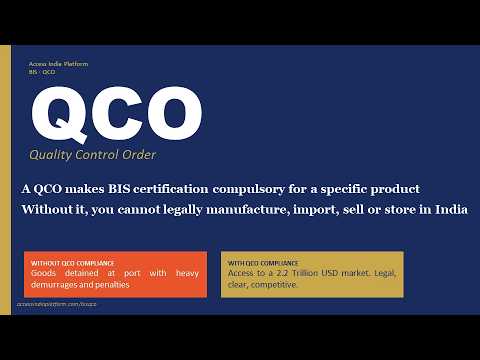
What is a Quality Control Order (QCO)?
India has always had product standards since 1947. What changed over the last decade is that compliance with those standards became mandatory. That shift is called a Quality Control Order,…
2026-05-25
CDSC
What is the Role of the Authorised Indian Representative Under CDSCO?
The Authorised Indian Representative (AIR) is a legally recognised entity appointed by a foreign medical device manufacturer to represent it before the Central Drugs Standard Control Organisation (CDSCO) in India.…
2026-05-25
DGFT
What is DGFT and what does it do?
The Directorate General of Foreign Trade is the apex body within the Ministry of Commerce and Industry, Government of India, responsible for administering all policy, licensing, and regulatory functions related…
2026-05-25
Articles
View all 15 →Customs & Detention
Your Goods Are Detained at Mumbai Port. Now What?
If Customs has detained your consignment at JNPT or Nhava Sheva for a Bureau of Indian Standards mismatch, demurrage and ground rent begin accruing from day one. You have four legal exit routes and a 30-day window before abandonment becomes the practical default. This article walks through what each route costs, what documents matter, and when to escalate.
8 min·2026-05-14
FMCS & Foreign ManufacturersThe FMCS Timeline: Why 8 Months is Never Enough
The Bureau of Indian Standards publishes a 6–9 month timeline for the Foreign Manufacturers Certification Scheme. The real calendar runs 9–14 months once application packaging, BIS officer travel, sample testing, and the marking-fee security deposit are accounted for. Importers who plan against the published figure miss their first shipment window.
9 min·2026-05-14
FMCS & Foreign ManufacturersChoosing an AIR: The Liability Nobody Talks About
An Authorised Indian Representative (AIR) is the legal stand-in that a foreign factory must appoint to obtain an FMCS licence from the Bureau of Indian Standards. Rule 11 of the BIS Conformity Assessment Regulations, 2018 makes the AIR statutorily liable for the foreign manufacturer's compliance — including penalties, suspension consequences, and downstream offences under the BIS Act, 2016. Choosing the AIR is therefore a contract negotiation, not an administrative formality.
8 min·2026-05-14
Case studies
View all 5 →Global First
Savera Group: Global-First BIS Certification under IS 17806
At the inception, there was no BIS precedent for IS 17806, no Product Manual, no Scheme of Inspection & Testing, no marking-fee structure and no alignment framework between European design…
2026-05-25
DPIIT ReliefItron India: DPIIT Relief for Import of Water Meters
BIS certification was stalled based solely on material specification deviations (Annex-B) despite zero concerns on safety, accuracy, or performance. Itron's products used globally accepted advanced materials while IS standards prescribed…
2026-05-25
Policy WinRegulatory Relief for the Indian Furniture Industry
The Furniture (Quality Control) Order introduced mandatory BIS certification for the sector. However, two provisions created disproportionate burdens, a rigid grouping norms that failed to reflect diverse product configurations, and…
2026-05-25
Latest regulatory updates → News
Need a regulatory steer on this product?
Speak to a regulatory counsel about your specific HSN, IS, and supplier situation.
Speak to an Expert Last verified against gazette notifications: 2026-05-25. Source: Hand-authored by Access India Editorial.
Related